
Experience Black Forest Tradition and Costume: The Bollenhut Hat
Discover the Bollenhut, the famous Black Forest costume from Gutach, Kirnbach and Hornberg-Reichenbach – experience tradition, culture and craftsmanship.
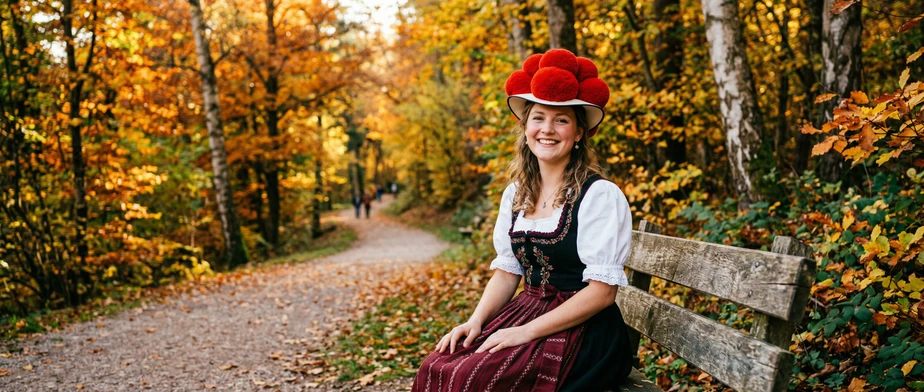
The Bollenhut is a straw hat stiffened with white plaster and topped with woolen pom-poms. It is part of the Gutach women's costume and the most striking headpiece of all Black Forest traditional costumes.
As a symbol of the entire Black Forest, the Bollenhut has become widely known. This is remarkable, because the Gutach costume and its distinctive hat were once just one of around 120 different costumes and were only worn in a very small part of the Black Forest.
The meaning of the Bollenhut
The Bollenhut is handmade and has been worn for more than two centuries by Protestant women in the villages of Gutach, Kirnbach and Hornberg-Reichenbach. Today it stands as an emblem for the whole Black Forest. The wide-brimmed white straw hat, which can weigh up to two kilograms, is part of the local folk costume and carries 14 woolen pom-poms of different sizes. Eleven of them are visible, three remain hidden. Seen from above, their arrangement forms the shape of a cross.
The color of the pom-poms varies. Unmarried women wear red pom-poms. Married women wear black ones. Girls are allowed to wear the red Bollenhut for the first time after their confirmation and keep it on until they marry. The hat is worn together with a black silk cap that is tied under the chin. Elderly women and small girls wear only this cap.
The wearer of the traditional Bollenhut reveals her identity with this headpiece and shows where she comes from, because this part of the costume is in principle reserved for locals. Above all, the black or red pom-poms signal from afar whether the woman is still single or not.
After the Bollenhut had almost disappeared from everyday life, it made a comeback through the popular "Heimatfilme" (homeland films) of the 1950s and 1960s. The film version of August Neidhart’s operetta "Schwarzwaldmädel" was especially influential. Starring Sonja Ziemann and Rudolf Prack, it attracted around 15 million cinema-goers. "Schwarzwaldmädel" was also the first German color film after the Second World War and went on to become one of the most successful German films of all time.
How the pom-poms came onto the straw hat
Today, only a few milliners still master the craft of making a traditional Bollenhut. Production is time-consuming handwork and therefore expensive. It can take about a week to complete a single hat, which is why a newly made Bollenhut can easily cost around 2,000 euros. The knowledge of how to make it is often passed down through families for generations. The hats themselves are also usually handed down from one generation to the next.
The headpiece with the red or black pom-poms originally started out as a rose hat. In other words, the hat was once decorated not with woolen pom-poms but with real flowers, in this case roses. In the cold season, however, fresh flowers were not available, which led to the idea of replacing the real roses with artificial ones.
Later, these artificial roses were replaced by woolen balls, possibly because silk and other materials were hard to come by.
At the Vogtsbauernhof open-air museum in Gutach you can watch a milliner at work making Bollenhut hats. You can also admire these distinctive headpieces at the costume museum in Haslach and at the Black Forest museum in Triberg, before returning to your holiday home in the Black Forest.
Firmly rooted in local customs
Around 1750, this unusual headpiece became established as part of church dress in the Gutach valley. With the growing popularity of straw hats, the Bollenhut gradually evolved into the form we know today.
An instruction issued in 1797 by the ducal Württemberg chancellery also played a role. It required that straw hats be decorated with the "customary ornamentation in black and red". Simple colored decorations were then replaced by woolen roses, which were eventually superseded by the red or black pom-poms.
The Gutach women’s costume is elaborate. It is defined by the Bollenhut, a black pleated skirt, a velvet bodice with floral embroidery, a collar scarf covering the neckline and a white blouse with puffed sleeves and a collar embroidered with glittering adornments.
The men’s costume is much simpler. It consists of black trousers and a white shirt, a black velvet waistcoat and a knee-length black velvet coat with red wool lining. A black tie and a velvet hat complete the outfit.
The Bollenhut and the associated costume of the Black Forest villages Gutach, Kirnbach and Hornberg-Reichenbach are still worn today on holidays and at traditional festivals. The costume is also an integral part of traditional weddings, church services and harvest thanksgiving celebrations. At church festivals such as the Easter Sunday resurrection service, the Gutach costume with its world-famous Bollenhut has a fixed place. Today, the Gutach costume is used across the Black Forest at many tourism events.
Unlike in many other regions where traditional costumes gradually disappeared, the Gutach costume survived and is now preserved as a cultural asset worth protecting. In 1950 and again in 1982, the Black Forest villages of Gutach, Kirnbach and Hornberg-Reichenbach tried in vain to register a patent for the Bollenhut in order to limit its use to the original communities.
More articles
Holiday Apartments & Hotels in the Black Forest: Comfort & Charm
Discover the best places to stay in the Black Forest: holiday apartments and hotels with comfort, modern style and beautiful locations in nature and lively towns.
Autumn Festivals in the Black Forest: Tradition, Culture and Insider Tips
Experience the autumn festivals in the Black Forest: tradition, culture and insider tips like Schluchsee. Holiday apartments offer the perfect base for your autumn getaway.

Mythical Mountains and Legends: Stories from the Black Forest
The Black Forest enchants with mythical mountains, mystical places, ancient legends, historic ruins and legendary hiking trails.
Discover Religion and Pilgrimage in the Black Forest
The Black Forest captivates visitors with pilgrimage sites, monasteries, pilgrimage routes and spiritual cultural landmarks full of history and contemplation.
Top Excursion Destinations in the Black Forest for Holiday Home Stays
Discover the most beautiful excursion destinations in the Black Forest: Höllental Railway, Europa-Park, Hexenlochmühle and more – ideal for holiday home guests.
Discover the Top 5 Attractions in the Black Forest
Discover the top 5 attractions in the Black Forest: experience Europa-Park, Triberg Waterfalls, Lake Titisee, the treetop walk and Hohenzollern Castle.
